

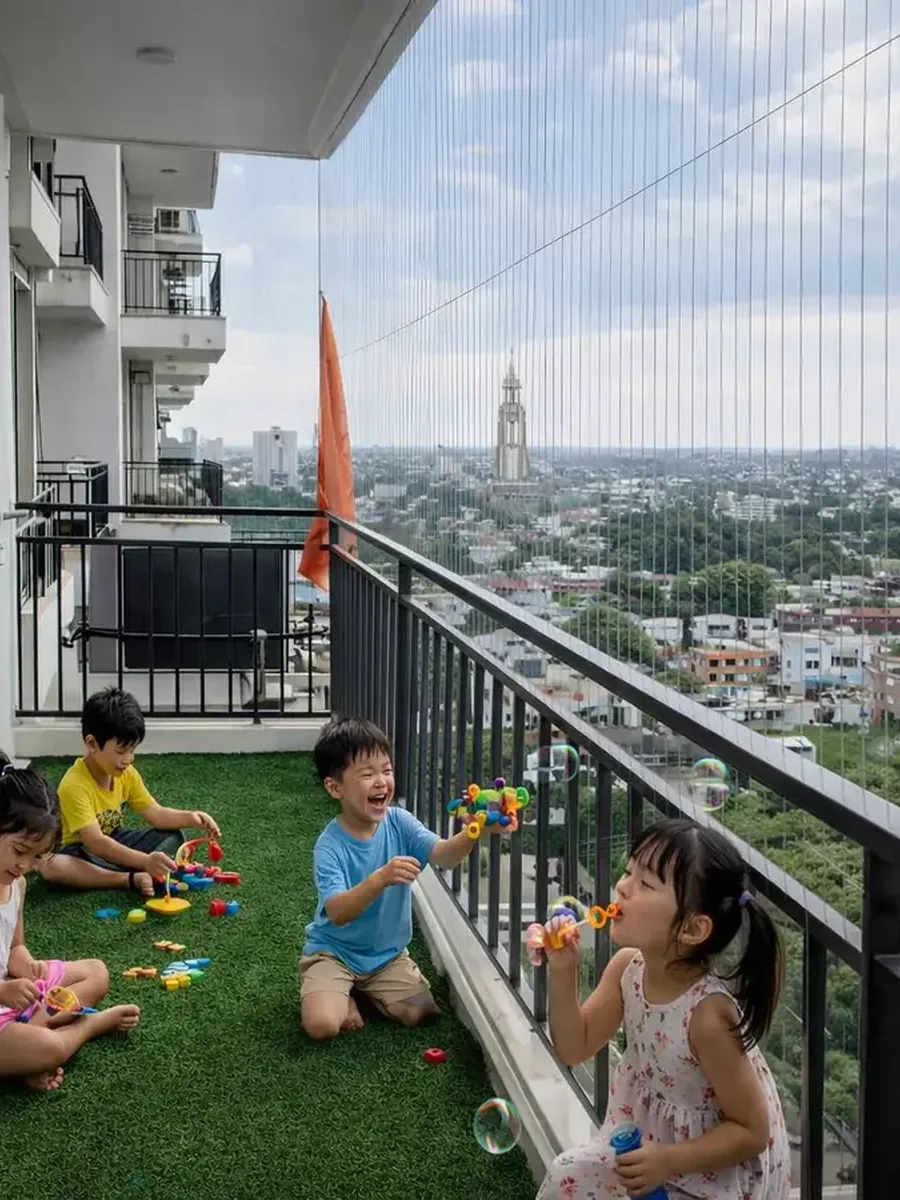
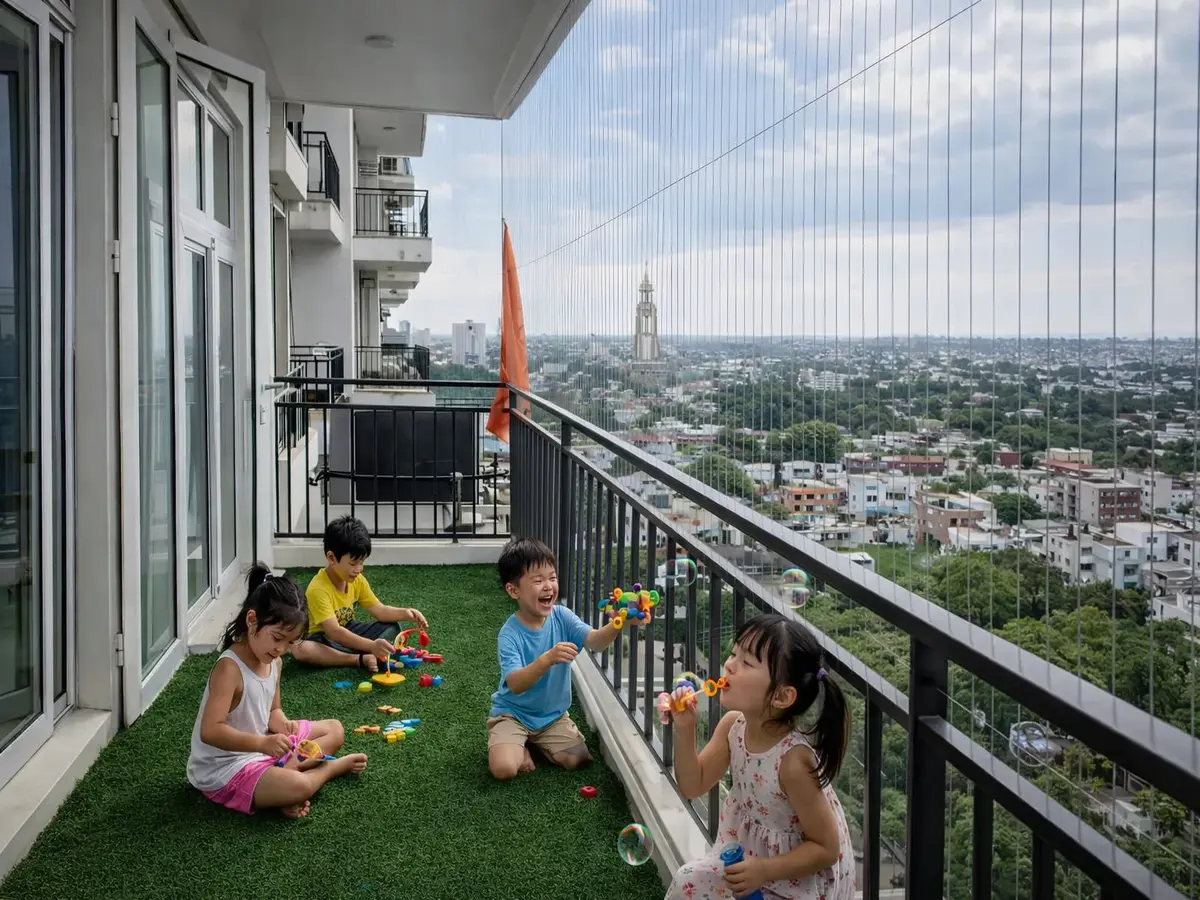
Service overview
Start with how a child reaches the opening
A useful survey looks beyond the size of the gap. It considers the route to it: movable stools, toy storage, window seats, low parapets and nearby furniture. Share which rooms your child uses, where adults need ventilation and whether visitors also bring young children. This makes the discussion more useful than ordering the same net for every room.
Children safety netting is one part of home safety planning. It does not remove the need to supervise children, manage access or maintain existing guards and railings. A bird net, mosquito screen or decorative mesh should never be assumed suitable for this purpose. The full proposed installation needs to be considered, including the product's intended use and how it connects to the building.
Typical requirements
- Family apartments
- Window openings
- Balconies
- Duplex edges
Important survey checks
- Climb points
- Furniture position
- Gap width
- Family routine
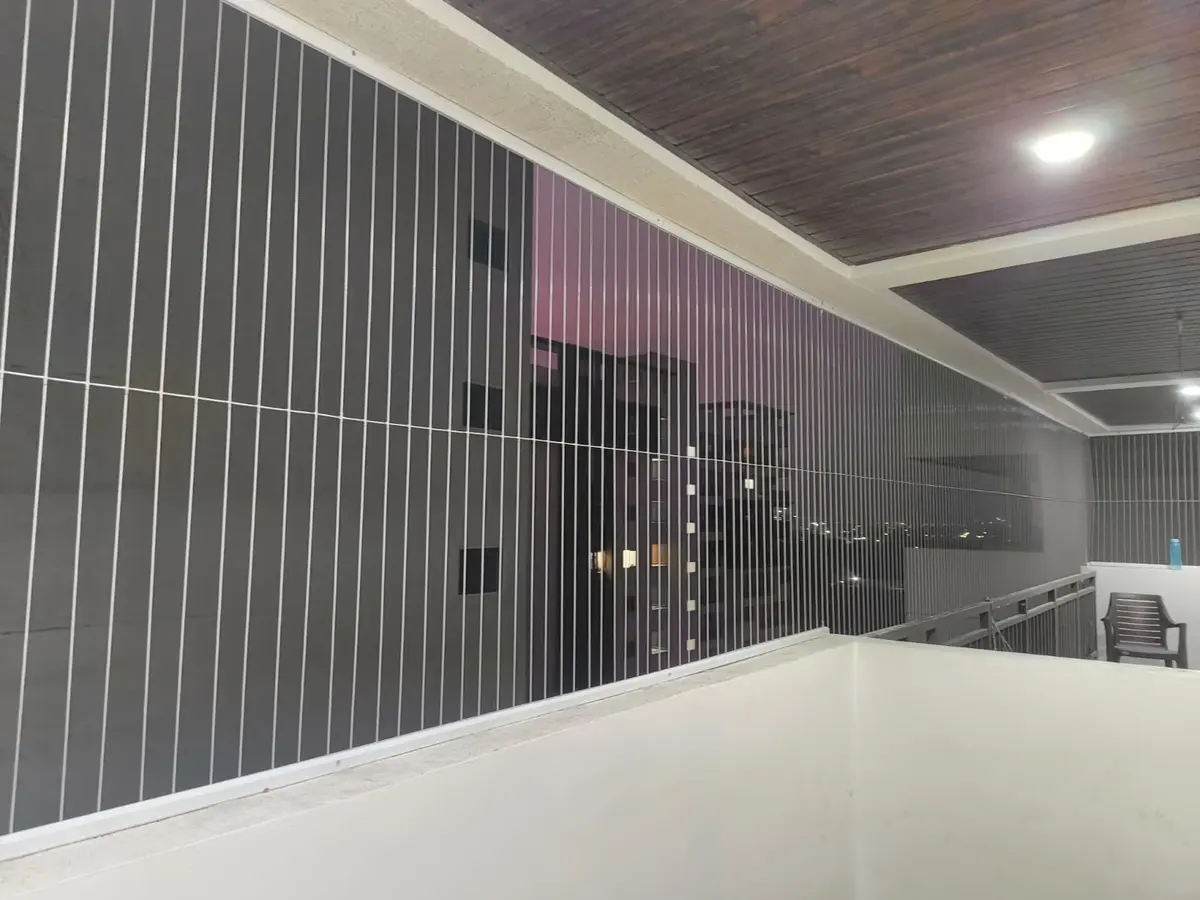
Review balconies, windows and landings separately
For a balcony, consider the entire open face, side gaps and anything a child could climb nearby. At a window, check the opening mechanism and the position of beds, desks and seating. On an upstairs landing, the risk may be a wide railing gap or an exposed side rather than the same enclosure problem found outdoors.
Discuss each location individually. A single order can still include different layouts, materials or additional work. If an existing railing or window fitting is loose or damaged, repair that underlying issue through the appropriate building professional. Netting should not be used to disguise a defect in the permanent barrier or to make an unsuitable opening appear finished.
- Include every accessible opening in the family discussion, even rooms used only occasionally.
- Identify furniture and stored items that make an otherwise high edge reachable.
- Explain any need for window operation, cleaning or emergency access before selecting a barrier.
Ask what makes the proposed system suitable for children
The words child safety on a quotation need supporting detail. Ask which net is proposed, what its manufacturer says about its intended application, how the perimeter is supported and which surfaces will receive the fixings. A statement about the strength of one strand is not a statement about the whole installed barrier. The attachments and building condition also matter.
Mesh size alone cannot answer every question. The installer should consider the complete layout, edge openings, potential entanglement points and how the material behaves in normal service. Avoid choosing solely by a photograph, colour or an unsupported weight claim. If a suitable design cannot be established for an opening, discuss a different permanent protective solution rather than accepting a convenient substitute.
Make the room layout work with the barrier
Move climbable furniture away from windows and balcony edges as part of the household plan. Revisit the arrangement when a new bed, shelving unit or play area is introduced. A net does not turn an open edge into play equipment. Children should not be encouraged to pull, climb, hang from or lean against it, even when an adult is nearby.
Explain the precautions to grandparents, caregivers and visiting family. Keep keys and access fastenings managed by adults where relevant, and ensure everyone knows how to report visible damage. The routine should be practical enough to continue after installation day. A clearly understood closed position is especially important if an access section must occasionally be opened for cleaning or maintenance.
Coordinate with owners, interior work and building access
In a rented home, discuss the proposed attachment locations with the owner before fixing work is agreed. Photographs and a written scope help explain what the installation involves. A no-drill preference is a constraint for assessment, not a reason to accept adhesive mesh or temporary ties as an equivalent child safety solution.
For a home undergoing interiors, schedule the survey with planned furniture and finishes in mind. A desk added beneath a window can change how that opening is reached; a false ceiling can conceal the structural fixing area. Share drawings or photographs where available. Confirm any emergency access requirements with the relevant building professional so a permanent enclosure does not obstruct an essential route.
Reassess the protection as the home changes
Ask for a simple handover explanation covering the visible perimeter, normal appearance and signs that need a professional revisit. Torn mesh, loose edges, exposed components or a fixing that moves should trigger action. Restrict access to the affected area while the issue is assessed. Do not invite a child to push against the net as a demonstration.
A room that worked for a crawling baby may be used differently by an active older child. Review the layout after moving furniture, replacing windows or adding a balcony storage unit. Net condition also needs attention after building repairs or accidental damage. Keep the installation details and contact information together so another caregiver can request help without guessing which product was fitted.
Compare options
Match the protective approach to each part of the home
The same household may need several kinds of assessment. The appropriate choice depends on access, building support and the intended protective function.
Balcony opening assessment
- Suitable for
- Families using a balcony with open front or side faces and reachable edges.
- What to consider
- Plan full coverage, furniture position and any access panel together; verify the selected system's suitability for the stated use.
Window protection assessment
- Suitable for
- Bedrooms, study spaces and living rooms with windows children can reach.
- What to consider
- Review window operation and purpose-designed guard or restrictor options with the relevant professional; insect screens are a separate product.
Landing and railing infill
- Suitable for
- A duplex landing or internal edge where existing railing openings need attention.
- What to consider
- Assess the whole railing and stair access separately. Netting must not stand in for a missing guard or a suitable stair gate.
Children Safety Nets pricing in Chennai
A children safety net quotation should describe the protection planned for each opening. Room count alone is not enough to establish the scope, and a generic per-square-foot figure cannot explain necessary support or access work.
Number and type of openings
A balcony enclosure, window opening and stair landing require different measurements and details. Ask for each location to be identified separately in the scope.
Suitability of the proposed system
Product selection, perimeter treatment and the intended protective purpose belong in the specification. Do not compare a child-focused assessment with a basic bird mesh quotation.
Existing building condition
Damaged railings, unsuitable finishes or inaccessible support may require additional assessment or repairs. Confirm these responsibilities before agreeing the fitting work.
Access and household coordination
Occupied bedrooms, renovation schedules and building entry arrangements affect how work can be organised. Any planned opening mechanism also needs clear inclusion.
What to confirm in your written quote
- List the balcony, window and landing openings that concern you.
- Send photographs showing each opening and nearby furniture.
- Mention children using the home and any additional pet or bird concerns.
- Describe window operation, cleaning needs and building access requirements.
- Share owner permissions, renovation plans and visible damage to existing guards.
Installation planning
From site assessment to handover
- 1
Discuss everyday access
Explain which rooms children use and where the concerns arise. Photographs of the surrounding furniture help build a fuller picture than close-ups of mesh or a railing gap alone.
- 2
Assess openings individually
Review the building support, existing barriers, proposed products and access requirements. The scope should distinguish what the installation can address from repairs or other protective measures that need a separate professional.
- 3
Agree and complete the fitting
Confirm the chosen approach for each opening before installation. Keep children away from the work area and coordinate with other contractors so the assessed supports and finished perimeter are not disturbed.
- 4
Explain ongoing precautions
At handover, review care, supervision, furniture placement and any access fastenings. Ask how visible damage should be reported and retain the written scope so future occupants or caregivers understand the installation's intended use.
Local considerations
Planning for your Chennai property
For family apartments in Velachery, Medavakkam or Pallikaranai, the useful starting point is the home's actual room layout. A study desk beside a window or a washing area opening onto a balcony may need a different arrangement from the main living room. Include these everyday spaces in the survey instead of focusing only on the most visible balcony.
In duplex homes around Tambaram, Porur and Anna Nagar, review the staircase, landing and upstairs windows as separate locations. Indoor netting may be less exposed to weather, but frequent contact and changes in furniture still matter. Keep handrails usable and discuss stair access measures independently from railing-gap infill.
For Chennai rental apartments and shared family homes, agree who will arrange inspections, report damage and approve any later alterations. Building painting or AC maintenance may be organised by someone outside the household. Let those contractors know about the protective installation before they begin work near its perimeter.
Explore the matching service guide for your area, then share the exact property location and access details with your enquiry.
- Anna Nagar
- Adyar
- Velachery
- Tambaram
- Sholinganallur
- Porur
- Ambattur
- Pallikaranai
- Thoraipakkam
- Medavakkam
- Perungudi
- Navalur
Frequently asked questions
Questions about children safety nets in Chennai
Is a pigeon net suitable for child safety?
You should not assume it is. A net intended to exclude birds may have a different product specification and fixing arrangement from a system assessed for child protection. Tell the installer the actual use and ask for the proposed product and complete installation details. Similar appearance does not make the two functions equivalent.
At what age should we review balcony and window safety?
Plan before a child can reach the opening rather than waiting for the first climbing attempt. Review again as mobility and room use change. There is no single net layout that automatically suits every age and home. Nearby furniture, the existing guard and how the room is used are all relevant to the assessment.
Does netting mean children can play alone on the balcony?
No. An installed barrier is an additional precaution and should not replace adult supervision or controlled access. Keep climbable objects away from edges and do not allow the net to become a climbing surface. The household should also understand what to do if any part of the installation is damaged or temporarily opened.
What if my child can reach the window from a bed?
Move the bed or other climbable furniture away from the window as part of the immediate room arrangement. Have the window protection reviewed, including its operation and any appropriate guard or opening-control options. An insect screen is not a child fall barrier. Discuss both the room layout and the opening itself when requesting an assessment.
Can you protect an indoor landing as well as a balcony?
Both locations can be assessed, but they need separate layouts. A landing may involve railing infill, a stairwell void or an open side, each with different support and access considerations. Netting does not replace a sound permanent guard or a suitable stair gate. Share wider photographs so the whole staircase arrangement is visible.
Can we install child safety netting in a rented flat?
Discuss fixing locations and the proposed work with the owner, then share any restrictions before measurement. The available support still has to suit the protective purpose. A promise to avoid all drilling cannot establish that a temporary method is adequate. Keep the written scope and clarify responsibility for removal or reinstatement when the tenancy ends.
What should I check after an installation is repaired?
Ask the installer to review the affected perimeter and explain what was replaced or reinstated. Confirm that any access section is back in its normal secured position and that surrounding work has not altered the layout. Keep children away while the issue remains unresolved. A neat-looking repair alone does not explain the condition of hidden fixings.
What details help you prepare a useful family safety quote?
Provide your Chennai locality, the openings of concern and photographs that include nearby furniture and existing guards. Mention whether the home is rented or being renovated, and explain any window or maintenance access needs. These details help establish what requires inspection and allow the eventual quotation to describe each location clearly.