
Service overview
Build the net plan around your practice sessions
A useful cricket net keeps the intended ball within a defined practice area while allowing the session to run sensibly. Think about who bats, where the coach stands, how bowlers enter and where waiting players collect. These details influence the lane arrangement as much as the available length and width, especially when several groups share the site.
Specify whether practice involves tennis balls, leather cricket balls, throwdowns or a bowling machine. A label such as sports net does not confirm compatibility with all of them. The proposed material, mesh, panel arrangement and supports should be assessed for the actual use. Netting also needs to work with an appropriate practice surface and a layout that separates active play from circulation.
Typical requirements
- Practice lanes
- Terraces
- Academies
- Society play zones
Important survey checks
- Ball direction
- Height
- Pole support
- Ground surface
Match the net to the ball and repeated impact
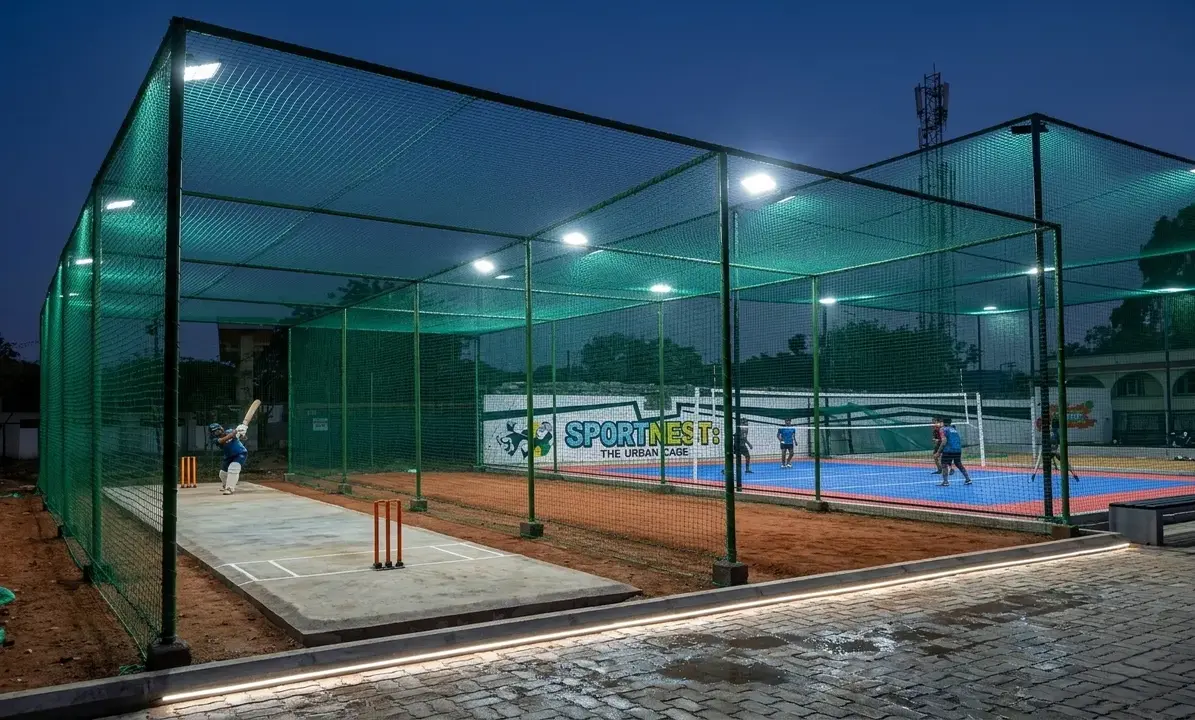
Ball size is only one part of selection. Repeated impacts around the batter, the direction of shots and the way the net is hung affect the complete arrangement. Ask for a product specification appropriate to the intended cricket ball and usage, rather than choosing a net solely by colour or a quoted twine thickness. A football boundary product should not be assumed suitable for cricket.
Discuss the treatment of high-impact areas and whether separately replaceable panels make sense for the facility. Their usefulness depends on the layout and how joins are finished. A properly assessed hanging arrangement also matters: tightening every panel as much as possible is not a universal improvement, because rebound and movement need consideration in a cricket practice environment.
Plan lanes, run-up space and player movement together
Start with a scaled layout showing batting positions, bowling approaches, entrances and the area outside each active lane. In a multi-lane facility, consider how a coach moves between groups without crossing a live ball path. Waiting players, kit bags and stored equipment should have a place that does not narrow the working space or become a trip obstacle.
Do not squeeze a standard-looking cage into a space that cannot accommodate the proposed session. The appropriate dimensions and clearances depend on the activity and require competent facility planning. If full bowling practice cannot be supported, discuss whether a different training activity is appropriate rather than presenting a restricted enclosure as a complete academy lane.
Consider roof coverage and the space beyond the nets
Map what lies beyond the practice zone: roads, neighbouring windows, parking, another pitch or a busy footpath. These surroundings influence containment planning and whether overhead coverage needs to be included. A side net can look substantial while still leaving a clear route for a lofted shot, a ball passing through a join or a low escape at an uneven surface.
Review entrances and panel intersections as part of the enclosure. An access opening should support the operating routine without leaving a predictable escape path during play. Net movement and clearance from nearby objects also need assessment, since an impact can push the mesh towards what is behind it. The designer should set the arrangement for the specific site and ball use.
Coordinate supports, playing surface and future replacement
A net replacement and a new practice facility are different scopes. For replacement work, inspect the existing frame, connections and panel dimensions rather than assuming all supports can be reused. For a new cage, clarify who provides the structure, foundations or fixings, playing surface and lighting. A netting quotation should not leave those major parts of the project ambiguous.
Outdoor support design needs to consider the net area and exposure, with qualified structural input where required. Keep lights, sharp surfaces and equipment clear of the moving net. Plan how worn panels will be accessed and replaced, and how any movable or retractable sections will be stored. Facility staff should know what changes require the affected lane to close for assessment.
Compare options
Cricket net layouts for different facilities
Choose a layout around the intended training and site constraints. The final dimensions, mesh and support specification should follow assessment rather than a one-size package.
Single practice lane
- Suitable for
- A defined coaching or practice session where one batting area can be separated from nearby activity.
- What to consider
- Review the ball type, bowling approach, coach position and escape routes. Include overhead containment where the assessed risk requires it, rather than treating it as a decorative extra.
Multi-lane academy enclosure
- Suitable for
- Schools, clubs or coaching facilities running several practice groups at the same time.
- What to consider
- Lane separation, player circulation and ball containment need to work together. Plan access to worn panels and keep storage out of routes between active training areas.
Net replacement on an existing cage
- Suitable for
- A facility with worn or damaged netting and an existing structure requiring condition assessment.
- What to consider
- Confirm the intended ball and any change in use. Recheck supports, panel fit, joins and entrances; copying an old net's measurements does not establish that the previous layout remains suitable.
Cricket Practice Nets pricing in Chennai
Cricket practice net prices in Chennai depend on the netted enclosure and what the project includes. Ask whether you are comparing replacement mesh, nets with supports or a wider facility project including surface work.
Lane count and enclosure coverage
Separate side panels, roof coverage, end panels and dividers affect the net quantity. Floor area alone does not describe the full amount of netting needed for a practice enclosure.
Ball and training intensity
The intended ball, impact pattern and frequency of use inform product selection. Ask for the relevant specification rather than assuming a thicker-looking net automatically suits hard-ball coaching.
Existing or new support structure
A serviceable assessed frame may change the scope compared with a new cage. State clearly whether support fabrication, foundations, structural review or repairs are included or separately arranged.
Access and related facility work
Installation access, removable sections and work around an occupied ground influence planning. Confirm whether surfacing, lights, equipment protection and disposal of old netting form part of the quotation.
What to confirm in your written quote
- State the ball type, player group, training activities and expected number of simultaneous lanes.
- Share dimensions and photographs showing the practice area and what lies beyond every boundary.
- Identify the bowler approach, coach position, player entrance and equipment storage area.
- Photograph existing supports and describe any damaged netting or ball escape problems.
- Request separate inclusions for net panels, supports, surface work, access and future replacement.
Installation planning
From site assessment to handover
- 1
Describe the training requirement
Share how the facility will be used, including ball type and simultaneous sessions. Identify the current problem, whether it is repeated ball escape, worn mesh or the need for a completely new practice arrangement.
- 2
Survey the practice area
Review dimensions, surrounding activity, access and existing supports. Assess the playing and circulation layout together, involving the appropriate facility or structural professional where the proposed scope requires that expertise.
- 3
Agree the enclosure and project boundaries
Confirm panel coverage, entrances, divider arrangements and the specified product. Establish who is responsible for the supporting structure, playing surface and related work before comparing the final quotation.
- 4
Review containment and operating arrangements
Check the completed scope with the facility representative and discuss appropriate commissioning for the intended use. Record care instructions, visible damage checks and the process for taking an affected lane out of service.
Local considerations
Planning for your Chennai property
For an academy or school enquiry around Anna Nagar, Ambattur or Mogappair, share the actual training timetable and how many groups overlap. Planning entrances and waiting areas around those sessions can be more useful than adding another lane that restricts movement through the facility.
A society practice area near OMR, Velachery or Medavakkam should identify the neighbouring uses around it, including parking and resident paths. The review needs to cover the ball's possible routes out of the enclosure, as well as the building or ground available to support it.
For a terrace proposal in Chennai, first establish that the roof and its access are suitable for the intended activity. Boundary protection, structural loading, waterproofing, noise and association requirements need separate consideration. A net cage by itself does not make a rooftop appropriate for hard-ball cricket.
Explore the matching service guide for your area, then share the exact property location and access details with your enquiry.
- Anna Nagar
- Adyar
- Velachery
- Tambaram
- Sholinganallur
- Porur
- Ambattur
- Pallikaranai
- Thoraipakkam
- Medavakkam
- Perungudi
- Navalur
Frequently asked questions
Questions about cricket practice nets in Chennai
Which net is suitable for a leather cricket ball?
Specify leather-ball use at the first enquiry and ask for a product and installation arrangement suitable for that use. Mesh, construction, repeated impact and the way panels are hung all matter. A generic sports or bird net should not be assumed compatible, and a material name or thickness alone is insufficient to select the system.
How much space is needed for a cricket practice net?
The appropriate space depends on the training activity, ball type, bowling approach and circulation around the lane. A qualified facility planner should establish the necessary dimensions and clearances for your intended use. Share the available area and session format first; a small cage cannot automatically be described as suitable for full bowling practice.
Do cricket practice nets need roof netting?
Overhead coverage may be needed where lofted shots could leave the practice area, but the decision depends on the complete layout and surrounding risks. Nearby roads, windows, parking and other activities should be identified. Have the roof, sides, joins and entrances assessed together so there is a coherent containment arrangement for the actual practice sessions.
Can cricket nets be installed on an apartment terrace?
A terrace proposal requires more than enough floor space for a net. The building structure, edge protection, access, waterproofing and surrounding property need assessment, along with permission from the responsible owner or association. Establish that the roof is suitable for the proposed cricket activity before selecting the cage or making claims about safe use.
Can the old frame be reused when replacing cricket nets?
Possibly, following assessment of its condition and suitability for the new net arrangement. Share photographs of the frame, connections and damaged panels, and describe any change in ball type or usage. Corrosion, movement or a previously ineffective layout should be addressed rather than hidden behind fresh mesh that matches the old panel dimensions.
Is cricket netting included with turf or pitch installation?
That depends on the agreed project scope. A quotation may cover only net replacement, a complete enclosure or additional playing-surface work. Ask for those items to be separated, including supports, foundations and lights where relevant. This makes it clear which contractor is responsible for each part before work is scheduled or materials are chosen.
Why do balls sometimes pass beneath or between nets?
Escape can result from gaps at the ground, poorly matched panels, damaged mesh or openings that are left unsecured during play. The cause should be assessed against the ball and the complete enclosure. Avoid fixing one visible hole while ignoring the rest of the route; review joins, entrance use and the surrounding surface together.
How should a cricket facility care for its practice nets?
Follow the supplied product guidance and include visible net condition in the facility's pre-use checks. Look for worn impact areas, broken mesh, loose connections and obstructions around active lanes. Close the affected area when damage compromises containment and arrange competent assessment. Keep bags and movable net sections stored where they do not obstruct player circulation.